Are you hunting wholesale aquarium suppliers in China? You fear bad quality and long delays. I show how to pick safe factories and build a profit-ready product line.
To find wholesale aquarium products suppliers in China, search by product category instead of using one broad keyword. Build separate supplier lists for low-risk accessories such as nets, decorations, and filter media; fragile products such as glass or acrylic tanks; and electrical items such as pumps, filters, heaters, and LED lights. Compare manufacturers on Alibaba, Made-in-China, Global Sources, Canton Fair, and CIPS, then check export experience, MOQ, QC process, material reports, certifications, packaging method, and communication speed. Before bulk ordering, request samples, confirm product specifications in writing, calculate CBM and shipping costs, and use inspection or payment protection for the first trial order.
Before you message a factory, stop and plan. One wrong order can cost a lot. Read on. I give clear steps, real checks, and a safe starter mix.
What aquarium products should pet retailers buy in bulk?
Not sure which items to buy in large amounts? Small parts sell again and again. I show a balanced starter assortment to test demand and avoid stuck inventory.
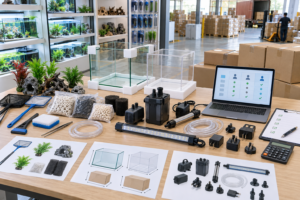
Pet retailers should buy a balanced wholesale mix of aquarium products: starter tanks or kits, filters and replacement media, air pumps, water pumps, LED lights, heaters, thermometers, substrates, decorations, nets, water conditioners, test kits, fish food, and cleaning tools. For steady resale, prioritize repeat-purchase items such as food, filter cartridges, water care products, and cleaning supplies, then add selected equipment in different tank sizes and price points. Be cautious with large glass tanks and electrical products because they require stronger packaging, higher shipping costs, safety documents, and better after-sales support.
Why a mixed starter matters
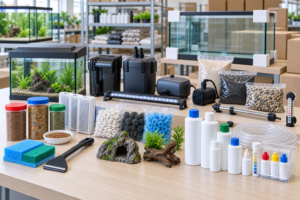
Most buyers think only of tanks. I disagree. Tanks sell once. Accessories sell again and again. A successful shelf needs both. I recommend a mix of fragile and consumable items. Fragile items like glass tanks build trust but risk damage. Consumables like filter cartridges and food bring repeat buyers. I have seen stores fail by buying too many large tanks and not enough replacement parts. That kills cash flow.
Safe starter assortment
- Small starter tanks / aquarium kits (desktop, 10-30L)
- Internal/Canister filters and spare cartridges
- Air pumps, small water pumps, tubing
- LED lights and simple controllers
- Heaters with thermostat
- Decorations, artificial plants, driftwood
- Substrates and gravel bags
- Nets, siphons, algae scrapers
- Fish food and water conditioners
- Cleaning tools and test kits
Risk table: product vs. risk level
| Product type | Risk level | Why it matters |
|---|---|---|
| Nets, plastics, decor | Low | Cheap, no electricity, easy to ship |
| Filters, pumps, lights | Medium | Functional parts, noise, warranty needs |
| Glass tanks, heaters | High | Breakage, leaks, electrical safety |
I always tell new buyers to split orders. Try several SKUs. Order one tank, two filters, three pump types, and a variety of small accessories. This reduces risk. It also shows which items sell in your market. Use real search terms like "bulk aquarium supplies", "aquarium starter kit wholesale", and "replacement filter cartridges wholesale" when you research.
How do you check aquarium product quality and safety before importing?
You cannot trust photos alone. You need tests, reports, and sample trials. I show the exact checklist I use before any shipment.
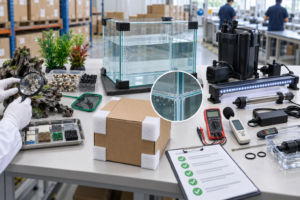
To check aquarium product quality and safety before importing, separate products into non-electrical accessories, fragile tanks, and electrical equipment. For decorations, substrates, nets, and filter media, check material reports, odor, sharp edges, coatings, color bleeding, and heavy-metal or chemical test results. For glass or acrylic tanks, verify thickness, seam quality, leak-test results, dimensions, and drop-tested packaging. For pumps, filters, heaters, and LED lights, review motor specs, voltage, wattage, noise, heat rise, IP rating, waterproof sealing, power adapter, and destination-market compliance documents such as CE, RoHS, FCC, UL, ETL, or other required reports. Always approve samples, confirm written specifications, and use pre-shipment inspection before paying the balance.
Core quality checks by product
I separate checks by product type. This helps you focus.
For glass tanks:
- Glass thickness and tolerance
- Edge polishing and cut quality
- Silicone sealing quality and bead size
- Dimensional accuracy and flatness
- Packing design, foam supports, double cartons
- Drop test videos and pallet loading photos
For pumps and filters:
- Flow rate and head specifications
- Noise level under load (dB)
- Motor type and expected life hours
- Waterproof standard (IP rating)
- Spare parts availability and motor plugs
- Warranty terms and spindle tests
For lights and heaters:
- Electrical safety certificates (CE/UL/FCC/RoHS)
- Waterproof class (IP67 or IP68 if submersible)
- Temperature control and fail-safe features
- LED lumen output and driver specs
Inspection and testing flow
- Request official certificates and raw material reports.
- Order functional samples and run them for 72 hours.
- Test pumps under head and noise conditions.
- Heat test heaters for stable temperature and auto shutoff.
- Check LED lights for flicker, waterproofing, and lumen drop.
- Ask for packaging design and run a simulated drop test.
Quick checklist table
| Check | Who provides | Why |
|---|---|---|
| Certificates (CE/UL/RoHS) | Supplier | Legal entry and safety proof |
| Raw material report | Supplier lab | Avoid toxic materials |
| 72-hour run test | Buyer or third party | Catch early failures |
| Pre-shipment photos/video | Supplier | Confirm packing and items |
| Third-party inspection | SGS/Intertek | Extra trust for big orders |
I always use pre-shipment videos. I also ask for spare parts in the first order. This prevents long downtimes for your customers. If a supplier hesitates to show tests, walk away.
How can you order private label aquarium products from China with a safe MOQ?
You can brand without big risk. Start small with low-cost branding steps. I outline a safe path to private label and how to keep MOQ low.
To order private label aquarium products from China with a safe MOQ, start with existing factory designs and low-risk branding such as logo stickers, printed boxes, manuals, barcode labels, and selected colors. For the first order, choose mixed SKUs with the supplier’s lowest workable MOQ per item and a practical total order value, often around USD 3,000, instead of opening new molds. Begin with accessories and consumables before private-labeling fragile tanks or electrical products. For pumps, filters, heaters, and LED lights, confirm samples, specifications, warranty terms, packaging, and destination-market compliance documents before production, and use payment protection or pre-shipment inspection for the trial order.
First steps for private label
Private label does not need custom molds. I start clients with easy branding. Stickers on products cost little. Custom color boxes help too. Manuals and UPC labels finish the look.
Practical private-label path
- Pick 5–10 core SKUs that sell well.
- Ask for OEM stickers, color box printing, and barcode labels.
- Request sample mock-ups before full run.
- Approve packaging and a small pilot batch.
- Use mixed SKUs to meet a total order value instead of high MOQ per SKU.
- Plan for private molds only after sales data proves demand.
Branding options table
| Branding method | Cost | Time | Risk |
|---|---|---|---|
| Sticker/Label | Low | 1–2 weeks | Very low |
| Custom Box | Medium | 2–4 weeks | Low |
| Custom Inserts (manuals) | Low | 1–2 weeks | Low |
| Custom mold/product shape | High | 6–12 weeks | High |
I normally recommend a total first order around USD 3,000 that mixes categories. This lowers risk and helps test different price points. At Petmmbear, I accept mixed orders to meet this target. This lets small retailers test the market without huge MOQ per SKU.
Conclusion:
Pick a mixed starter assortment, verify quality with real tests, and start private label with low-risk branding steps to grow safely.
Petmmbear is a full-category aquarium and pet supply factory. I run a factory with 32 production lines. We serve global markets and keep about a 97% customer satisfaction rate. If you want steady suppliers, help with mixed MOQ, or private-label options, contact me via our website form at www.petmmbear.com or email [email protected]. Let's plan your first safe order and build a reliable product line together.