Many buyers pick bandanas by picture and lose sales. I saw this happen when fit and wash failed on a big order.
Buy dog bandanas wholesale from China by sourcing verified suppliers on Alibaba, Global Sources, or direct pet accessory and textile factories in Yiwu, Shanghai, or Guangdong, then choose cotton, polyester, reversible, cooling, or seasonal styles in triangle, slide-on, collar-loop, or square scarf formats. Before bulk ordering, request samples to check stitching, fabric weight, colorfastness, print sharpness, OEM/ODM logo method, retail packaging, MOQ, lead time, and express or sea-shipping cost.
You must avoid one big mistake. Buyers treat all bandanas the same. That kills margin and trust. Read the checks I use.
What types of dog bandanas should retailers and groomers buy in bulk?
Many buyers mix styles without a plan and get stuck with slow SKUs. I learned to split buyers into two groups early.
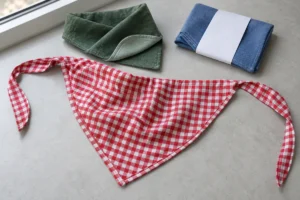
Retailers and groomers should buy tie-on triangle bandanas with V-neck curves, over-the-collar slide-on bandanas, reversible or dual-sided bandanas, and blank bandanas for customization. Groomers should prioritize washable cotton or poly-cotton V-neck styles with overlocked edges and XS–XL size mixes, while retailers should stock collar-loop, seasonal, holiday, and reversible designs with retail-ready packaging.
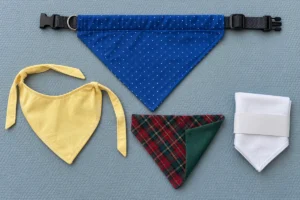
I separate groomer orders and retailer orders. I sell simple tie-on triangles to groomers. I offer reversible and over-the-collar styles to retailers. I test two everyday prints and one seasonal print first. I pick two size ranges. That gives six SKUs. I keep seasonal prints small. I work back from the sale date for holidays. I ask the supplier for sample lead time plus inspection and freight time. I avoid late arrivals. I pick tie-on triangles for low price channels. I pick collar-channel bandanas for higher price channels. I prefer reversible designs for premium offers. I also watch fabric weight. I choose fabrics by feel and drape. I check finished dimensions, not S/M/L tags. I check seams and edge finish. I plan displays that show how bandanas fit on a collar. I pair bandanas with collars or leashes in mixed orders. I do this to reduce SKU risk and raise basket size.
How do you compare wholesale dog bandana prices, quality, and profit margins?
Many quotes say "100% cotton" and hide big differences. I once compared two cotton quotes and found one was 80gsm and one was 120gsm.
Compare wholesale dog bandanas by landed cost per sellable unit, not just the supplier’s unit price. Check quantity breaks, MOQ, custom printing fees, packaging, freight, and platform fees, then compare fabric type, GSM, stitching, edge finish, closure quality, colorfastness, size range, and sample consistency against your target retail price. A healthy margin should cover product cost, shipping, duties, packaging, transaction fees, returns, and still leave room for profit.
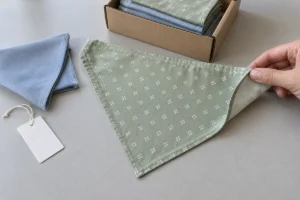
I always ask for full specs. I ask for fabric GSM and weave. I ask for finished measurements. I ask how the edge is finished. I ask for a sample print. I wash the sample three times. I measure after each wash. I test color transfer on white cloth. I test seam and snap strength. I test the collar channel on an actual collar. I test drape and knot size on tie-on styles. I check print feel. I check whether the print cracks or peels inside the knot. I write acceptance limits and ask the supplier to sign them. I get a pre-production sample and a production sample. I order a few dozen samples before full runs. I calculate landed cost per unit. I add packaging, freight, duty, insurance, and a returns allowance. I also add my ad and fulfillment costs. I test a few selling prices then estimate contribution margin. I prefer a simple model: landed cost, wholesale price, retail price, and gross margin. I avoid decisions from FOB alone.
How can you order custom dog bandanas in bulk with a manageable MOQ?
Many buyers jump to full custom prints and face very high MOQ by fabric or color. I teach a staged private-label path.
Order custom dog bandanas in bulk with a manageable MOQ by choosing low-minimum wholesale or OEM/ODM suppliers that use stock shapes with custom printing, labels, or packaging instead of fully custom patterns. Start with tie-on or over-the-collar styles, use dye sublimation for small full-color runs or screen printing for simple logos, request a digital proof and sample, then confirm fabric, sizes, logo placement, MOQ, lead time, packaging, and landed cost before scaling.
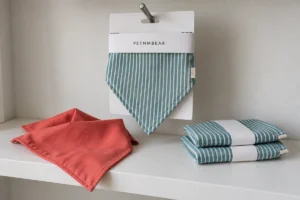
I follow a four-step private label plan. Step one is soft branding. I add woven labels, hangtags, stickers, or printed sleeves. Step two is small SKU testing. I pick two prints and two sizes. I order enough to test real sales. Step three is math and MOQ clarity. I ask the factory what MOQ means for each item. I ask whether MOQ applies to print, fabric color, or packaging. I convert weight-based MOQ into unit counts. I then split the MOQ across mixed items when possible. Step four is scale after proof. I only invest in custom prints or fabrics after 60–90 days of sales data. I negotiate tooling or print setup amortization in the next order. I also require artwork ownership in writing before using custom designs. I ask for a production mockup showing logo placement and tag positions. I also set clear lead times for seasonal orders. I avoid late shipments by confirming production, inspection, freight, and customs times early. I prefer flat packing for basic lines. I reserve presentation boxes for premium lines only after the SKU proves itself.
Conclusion
Define buyer type, set firm specs, test washed samples, and start small with mixed SKUs.
I am Jerry at Petmmbear. We are a full-category pet supply factory in China. We run 32 production lines across Shenzhen, Yiwu, and Hefei. We make collars, leashes, bandanas, beds, toys, grooming tools, and smart pet devices. We handle design, testing, packing, and mixed-category B2B orders. Our orders start around USD 3,000 for mixed runs. Our customer satisfaction rate is about 97%. Contact me via the inquiry form at www.petmmbear.com or email [email protected].